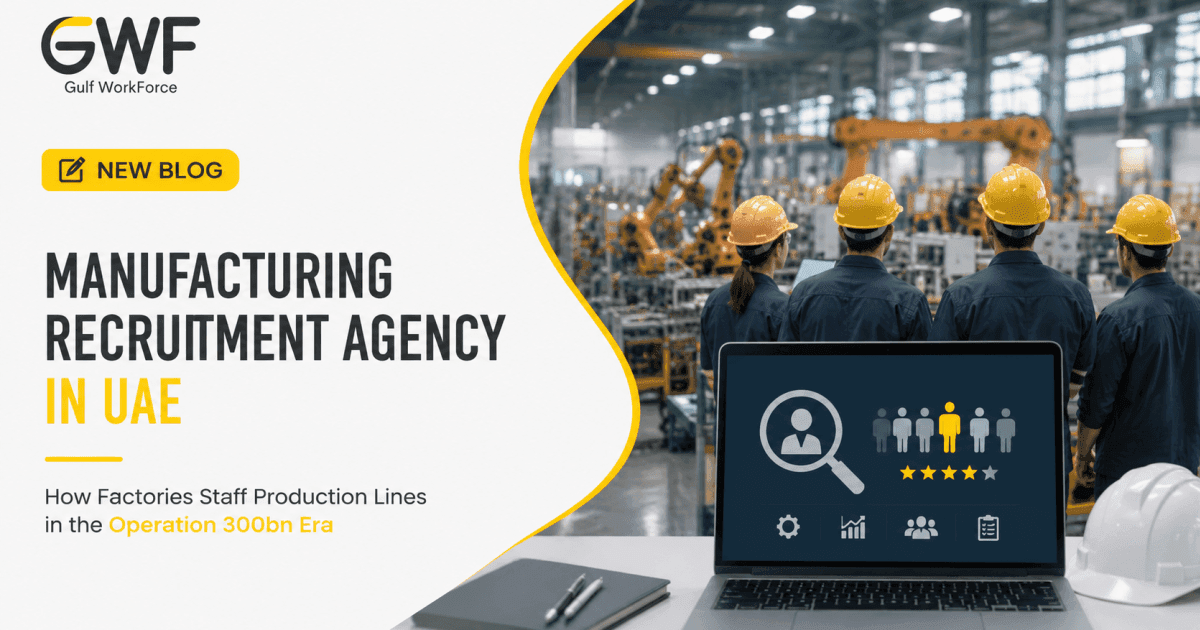
Manufacturing Recruitment Agency in UAE:
Staffing the Operation 300bn Factory Boom
The UAE is industrializing on a national deadline. Operation 300bn - the federal strategy to lift industrial GDP to AED 300 billion by 2031 - is filling KEZAD, Dubai Industrial City and free zones across the Emirates with new factories, and every one of them shares the same day-one dependency: trained people on the line. A manufacturing recruitment agency in UAE exists to close that gap - machine operators, QC inspectors, maintenance technicians and supervisors, mobilized to match commissioning schedules that investors are watching.
Factory staffing punishes improvisation: lines run at the pace of their least trained station, quality escapes cost recalls, and a commissioning delay burns capital. This guide covers the roles and 2026 rates, the production-specific screening that predicts performance, and how staffing plans should track your ramp curve.
AED 300B Industrial GDP target under Operation 300bn by 2031 | 24/7 Shift patterns most UAE plants run once commissioned | 3–6wk Overseas mobilization window for trained operators | 2–3× Headcount multiplier from single-shift pilot to full production |
Sources: UAE Ministry of Industry and Advanced Technology (Operation 300bn) · UAE manufacturing sector analyses 2026 · Gulf Workforce market data
The Factory Boom Is a Hiring Boom
Industrial strategy converts to headcount with unusual directness: every announced plant - food processing, pharmaceuticals, packaging, metals, building materials, assembly - publishes a capacity figure that implies an org chart. And unlike office hiring, factory workforces arrive in structured waves: a commissioning crew, a single-shift pilot team, then the doubling and tripling to two- and three-shift operation.
Each wave has a deadline tied to equipment vendors, financing covenants and offtake contracts. The plants that hit their ramp curves treat staffing as part of the commissioning plan - the same wave logic behind hiring 100+ employees fast in the UAE - not as something HR catches up on after mechanical completion.
The Roles and 2026 Market Rates
Rates include visa, insurance, accommodation and transport at typical terms. Food and pharma plants add hygiene-certification requirements; verify against your specifications.
Role | What Matters Most | Typical Fully-Loaded Monthly Cost (AED) |
|---|---|---|
Production line workers | Pace, consistency, safety discipline | 1,600 – 2,200 |
Machine operators | Machine-specific experience — verify hands-on | 2,200 – 3,200 |
Forklift & material handlers | Certified licences; warehouse interface | 2,200 – 3,000 |
QC inspectors | Measurement literacy, documentation habits | 2,800 – 4,000 |
Maintenance technicians | Electrical/mechanical troubleshooting depth | 3,500 – 5,500 |
Production supervisors | Shift leadership, output accountability | 5,000 – 8,000 |
💡 Screen on the Machine, Not the CV. Manufacturing CVs are the least predictive in any industry - "machine operator, 5 years" says nothing about which machines, what tolerances, or whether the candidate ran the line or watched it. Specialist screening is practical: operators tested on comparable equipment at origin, QC candidates given real measurement exercises, technicians walked through fault-finding scenarios. An hour of practical testing in the sourcing country saves a month of discovering the truth on your line - at your scrap rate's expense.
Staffing the Ramp: Waves, Not Vacancies
The staffing plan that works tracks the commissioning curve. Wave one: maintenance technicians and supervisors arrive early enough to sit alongside equipment vendors during installation - the cheapest training your plant will ever get. Wave two: the pilot-shift operator cohort, mobilized 3–6 weeks ahead of first production via the corridor machinery in our India hiring guide - India's industrial belt supplies the bulk of the UAE's experienced operators. Wave three and beyond: shift multiplication through supplied labour, which lets output scale with orders instead of fixed payroll - the manpower supply model applied to production. Plants also inherit a compliance layer many industrial employers miss: manufacturing sits inside the 14 sectors covered by Emiratisation requirements, so quota planning belongs in the org chart from wave one.
⚠️ The Commissioning Trap: People Arrive After the Machines. The most common - and most expensive - sequencing error in UAE manufacturing: equipment commissioning booked to the day, workforce recruitment started afterwards. Vendors' engineers fly in, machines run acceptance tests with nobody to train, and the plant pays for a second vendor visit - or worse, self-trains from manuals. Overseas operator mobilization takes 3–6 weeks; vendor schedules are booked months out. Put the hiring milestones on the same Gantt chart as mechanical completion, and let each wave land two weeks before it is needed.
5 Factory Staffing Mistakes - And What They Cost
Mistake | Cost | How Gulf Workforce Prevents It |
|---|---|---|
Recruiting after mechanical completion | Idle plant, repeat vendor visits | Hiring waves mapped to the commissioning Gantt |
CV-based operator selection | Scrap, rework and line stoppages | Practical machine testing at origin |
Flat headcount for a ramping plant | Overstaffed pilot or understaffed full production | Core-plus-supply waves matched to shifts |
Ignoring Emiratisation from day one | Fines landing mid-ramp | Quota roles designed into the org chart |
No maintenance bench | One resignation stops a 24/7 line | Technician pipelines and standby cover |
How Gulf Workforce Answers This
Gulf Workforce recruits and supplies factory workforces across the UAE and GCC - for new plants, expansions and running operations in food, pharma, packaging, metals and assembly. When you staff through Gulf Workforce, you get:
Machine-tested operators - practical assessments at origin against your equipment types
Commissioning-aligned waves - technicians early, operators on the ramp, cohorts via bulk hiring services in the UAE
Shift-multiplication supply - scale from one shift to three without fixed-payroll risk
Industrial-corridor sourcing - India's manufacturing belt plus parallel pipelines
Compliance built in - MOHRE, WPS and Emiratisation quota planning from wave one
Transparent pricing - itemized rates per our fees guide
The Takeaway: The Ramp Curve Is a People Curve
Operation 300bn will be delivered by machines that arrive on ships and people who arrive on planes — and only one of those has a procurement plan in most projects. Put the workforce on the same schedule discipline as the equipment: specified by wave, tested before selection, mobilized against the Gantt, flexed with supply as shifts multiply. Factories that do this hit their capacity numbers; factories that don't explain variances to their boards.
Frequently Asked Questions
1. What does a manufacturing recruitment agency in UAE actually do?
It sources, screens and mobilizes factory workforces - machine operators, QC inspectors, maintenance technicians and supervisors - against a plant's commissioning schedule, and can supply labour on a flexible basis so headcount scales with shifts instead of sitting on fixed payroll.
2. How much does it cost to hire factory workers in the UAE in 2026?
Fully-loaded monthly costs (including visa, insurance, accommodation and transport) typically run AED 1,600–2,200 for production line workers, AED 2,200–3,200 for machine operators, and up to AED 5,000–8,000 for production supervisors, depending on role and certification requirements.
3. How long does it take to mobilize machine operators for a new UAE factory?
Overseas mobilization for trained operators typically takes 3–6 weeks. Maintenance technicians and supervisors should be brought in earlier - ideally alongside equipment vendors during installation - rather than after mechanical completion.
4. Does Emiratisation apply to manufacturing companies in the UAE?
Yes. Manufacturing is one of the 14 sectors covered by UAE Emiratisation requirements, so Emirati quota planning needs to be built into the org chart from the first hiring wave, not added after the plant is running.
5. What's the difference between hiring production workers directly and through supplied labour?
Direct hiring fixes headcount to payroll regardless of shift changes; supplied labour lets a plant scale from a single-shift pilot to two- or three-shift production - typically a 2–3× headcount multiplier - without carrying that cost as permanent staff.
6. Why does CV-based hiring fail for machine operators?
A CV listing "machine operator, 5 years" doesn't show which machines, what tolerances, or whether the candidate actually ran the line. Practical, equipment-specific testing at the sourcing origin predicts on-the-job performance far better than experience claims alone.
Staffing a Factory or Production Facility in the UAE?
Tell us the roles, shifts and commissioning dates. Gulf Workforce responds with a wave plan, testing pathway and itemized quote within 24 hours.
📋 Employers — Discuss your factory staffing with our team
📞 Call us — Contact Gulf Workforce directly
🔍 Learn more — Read our complete Bulk Hiring Services UAE guide